
In the instrument post, the investor offered to invest $50,000 at a $4 million Fully Diluted Valuation.
In equity, valuations are typically described as being calculated on a “fully diluted basis,” while in tokens the term usually appears as a “fully diluted valuation”.
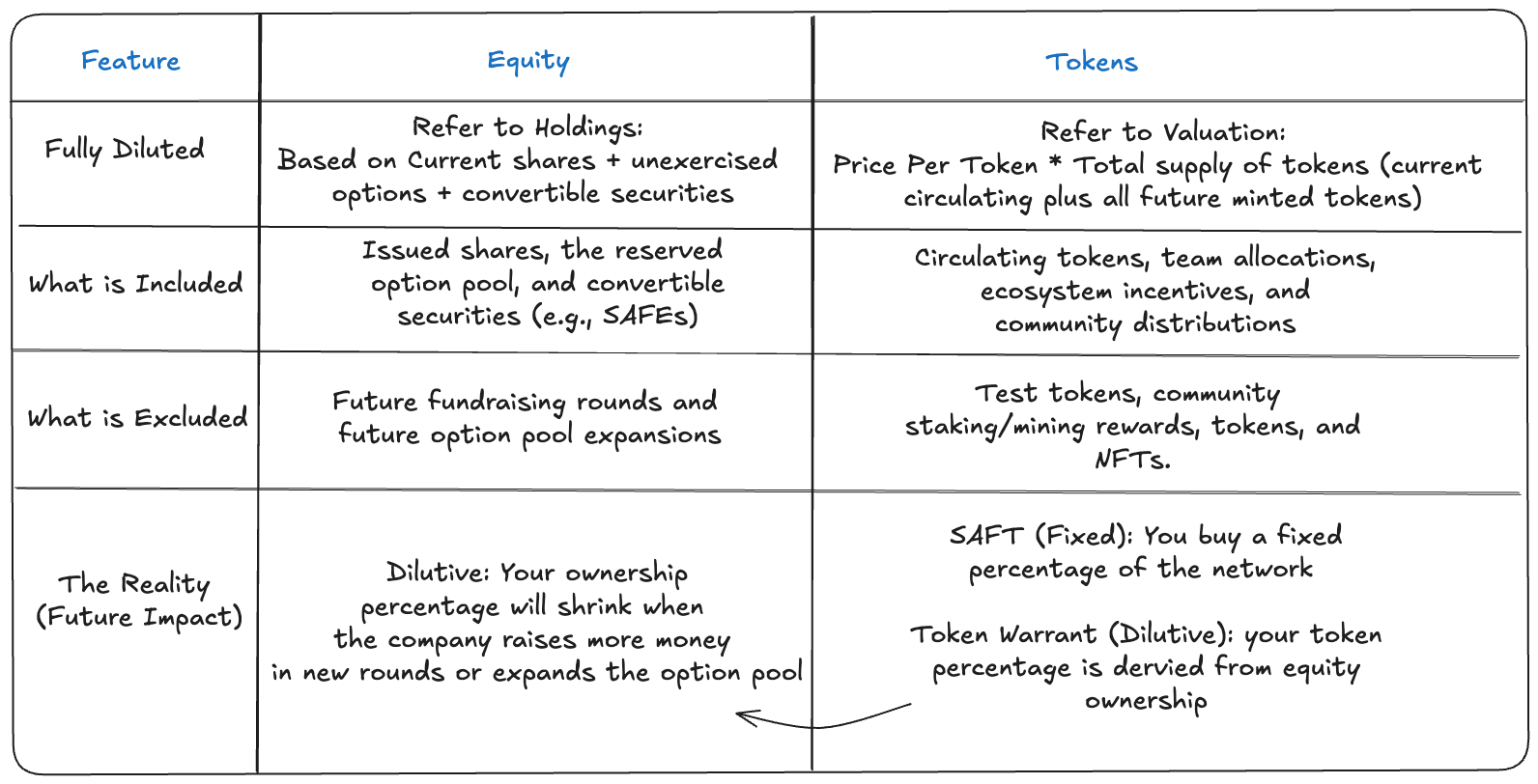
The term Fully Diluted is used for equity and tokens, but it has a different meaning for each.
The Confusion
When we use the term fully diluted basis, we refer to ownership of equity. When we use the term fully diluted valuation in a token context, we refer to valuation.
But beyond that, these terms comprise different components, which are not intuitive:
In equity, it is clear that “fully diluted basis” includes all shares currently held by shareholders. But does it also include options granted, or SAFEs that have not yet converted into shares?
In tokens, it is clear that fully diluted valuation includes tokens in circulation. But what if the project’s governance later decides to issue additional tokens to incentivize participants? Are those included in the valuation as well?
Let's break it down:
Fully Diluted in Equity
In equity, “fully diluted” refers to a shareholder's ownership of the company, based on the total number of shares that would exist if all rights to receive shares were exercised. This includes:
- Issued Shares: Shares already held by founders, employees, and investors.
- The Option Pool: Shares reserved for future hires, even if those options have not yet been granted.
- Convertible securities: Rights to receive shares in the future, such as SAFEs, convertible notes, and similar instruments.
When the company raises additional funding and issues new shares to investors or expands the option pool beyond what was reserved, the fully diluted share count increases. As a result, the percentage ownership of existing investors decreases: the number of shares they hold remains the same, while the total number of shares in the company increases.
Fully Diluted in Tokens
In tokens, fully diluted valuation (FDV) generally refers to the value of the network assuming the entire token supply is in circulation. The fully diluted valuation is the total network price, equal to the product of total supply and the price per token.
This includes tokens currently circulating, and all tokens allocated or that will be allocated to the team, future rounds, ecosystem incentives, and community distributions. The term usually excludes: test tokens; tokens issued through staking rewards or mining (as long as they are issued by the protocol to the community and not selectively to insiders or the company), and NFTs. Note, that some FDV calculations do count future staking rewards and mining emissions in the definition of FDV, though they are commonly excluded in the standard Token Warrant definition.
The situation above is true for SAFT investments.
However, this becomes confusing when the investor invests through a SAFE and a token warrant.
In these cases, as discussed in a previous post, the investor’s token allocation is determined based on the equity ownership they receive through the SAFE. As a result, if the company issues additional equity before the token launch which dilutes the holdings of the investor, it will respectively reduce the number of tokens the investor ultimately receives.
Summary
Fully Diluted Basis in equity refers to a shareholder's ownership percentage after all current rights to shares are converted into shares. That percentage drives what they receive in an exit event or dividend distribution, as well as their voting power in a shareholders' meeting. It will shrink over time: every future round or option pool expansion adds shares, so an investor holding the same number of shares ends up owning a smaller portion of the company.
Fully Diluted Valuation in tokens refers to the value of the project assuming all existing and future tokens are in circulation, and equals the total supply multiplied by the price per token. It is used to assess the price of the project, and also feeds metrics like the Market Cap / FDV ratio, which shows how much of the supply is actually circulating.
We noted that while in SAFT deals the investor purchases a fixed portion of the supply, when investing through a SAFE + Warrant, the investor's holdings may be diluted by future rounds, which impacts the economics of the deal.