

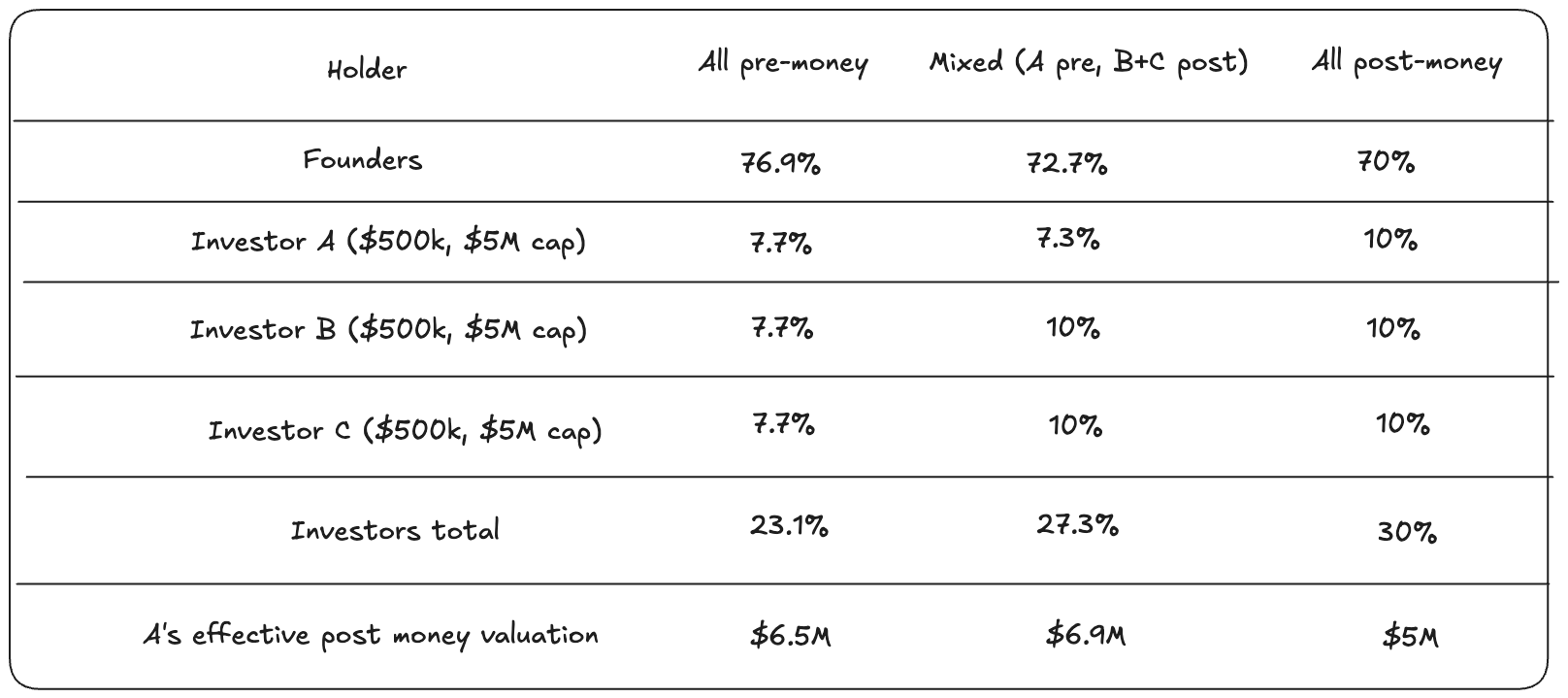
$1.5M raised, $5M cap, three SAFEs. The pre-money SAFE leaves founders at 76.92%; the post-money SAFE leaves them at 70.00%.
The company raised the same $1.5M. The valuation cap was the same. The number of SAFE rounds was the same. But the founders gave up significantly more ownership under the post-money SAFE.
Pre-Money vs Post-Money SAFEs
SAFEs can have either a pre-money valuation cap or a post-money valuation cap.
Pre-money SAFE: Each SAFE investor is diluted by other SAFEs.
Post-money SAFE: Investors get the anti-dilution protection – their ownership percentage is fixed at the time of investment. Other SAFEs do not change the investor’s ownership percentage in the company.
The issue that gets worse in crypto companies
In crypto, startups often raise through multiple post-money SAFEs over several years. These companies, whose focus is mainly on the network (i.e., tokens) rather than the company (i.e., shares), avoid priced rounds and instead use more and more post-money SAFEs, which are quick to close and inexpensive.
The more post-money SAFEs the company uses, the more existing shareholders (mostly founders and employees) absorb the dilution caused by the new money invested in the company. As long as the SAFEs exist, SAFE investors are not diluted by other SAFEs.
How to Avoid This
To avoid this, founders can use pre-money SAFEs (which are much less favored by VCs, though angel investors are likely be less sensitive to them).
In addition, to alleviate the dilution, the founders should make sure that SAFEs are converted into equity more frequently. This will not change the anti-dilution the post-money SAFE receives as long as the SAFE is effective, though from the moment the SAFEs convert to shares, they start sharing the dilution for future issuance of equity and SAFEs with all shareholders, including the founders (more on this in the next blog).
Nevertheless, if founders continue to raise capital with multiple post-money SAFEs, they should at least model it on a cap table and understand their dilution with each new SAFE the company issues, so they can monitor and ensure they are not over-diluted themselves. Today it has become very easy to model the cap table using AI tools – just give any AI platform the details about the company's fundraise, and it can easily illustrate a cap table with anticipated dilution.
Most VCs insist on post-money because it removes uncertainty about the most important issue – how much they hold in the company. They want to know exactly how much ownership they are buying. That certainty is also why post-money became the market standard: it makes the round easier to negotiate and close, and creates full alignment of interests among SAFE investors.
Note that the Y Combinator template is a post-money SAFE.
Mixed Rounds
Mixed rounds, where the company issues pre-moeny SAFEs to some investors and post-money SAFEs to others, are not the market standard but are commonly seen.
In this event, the effective valuation at which the pre-money SAFE investor is investing will go higher as more SAFE investors join the round, and it will increase even more sharply if other investors are issued a post-money SAFE.
You can see the illustration below, which breaks down how much each investor holds in the company, for an investment of three $500k SAFEs at a $5M cap, in the following three scenarios:
1) all investors invest with a pre-money SAFE
2) a mixed scenario where only investor A invests with pre-money SAFE and investors B and C invest with post-money SAFEs.
3) all investors invest with a post-money SAFE
Summary
Post-money SAFEs give certainty to the investor, but they often lead to higher dilution for existing shareholders when multiple SAFEs are issued. As a founder, if you continue issuing post-money SAFEs, model a few scenarios and monitor your dilution, as it can be detrimental. Make sure you are converting the SAFEs to equity from time to time so investors start sharing dilution together with the founders.