

Two companies raise $16M across three rounds with the same investment amounts and valuations.
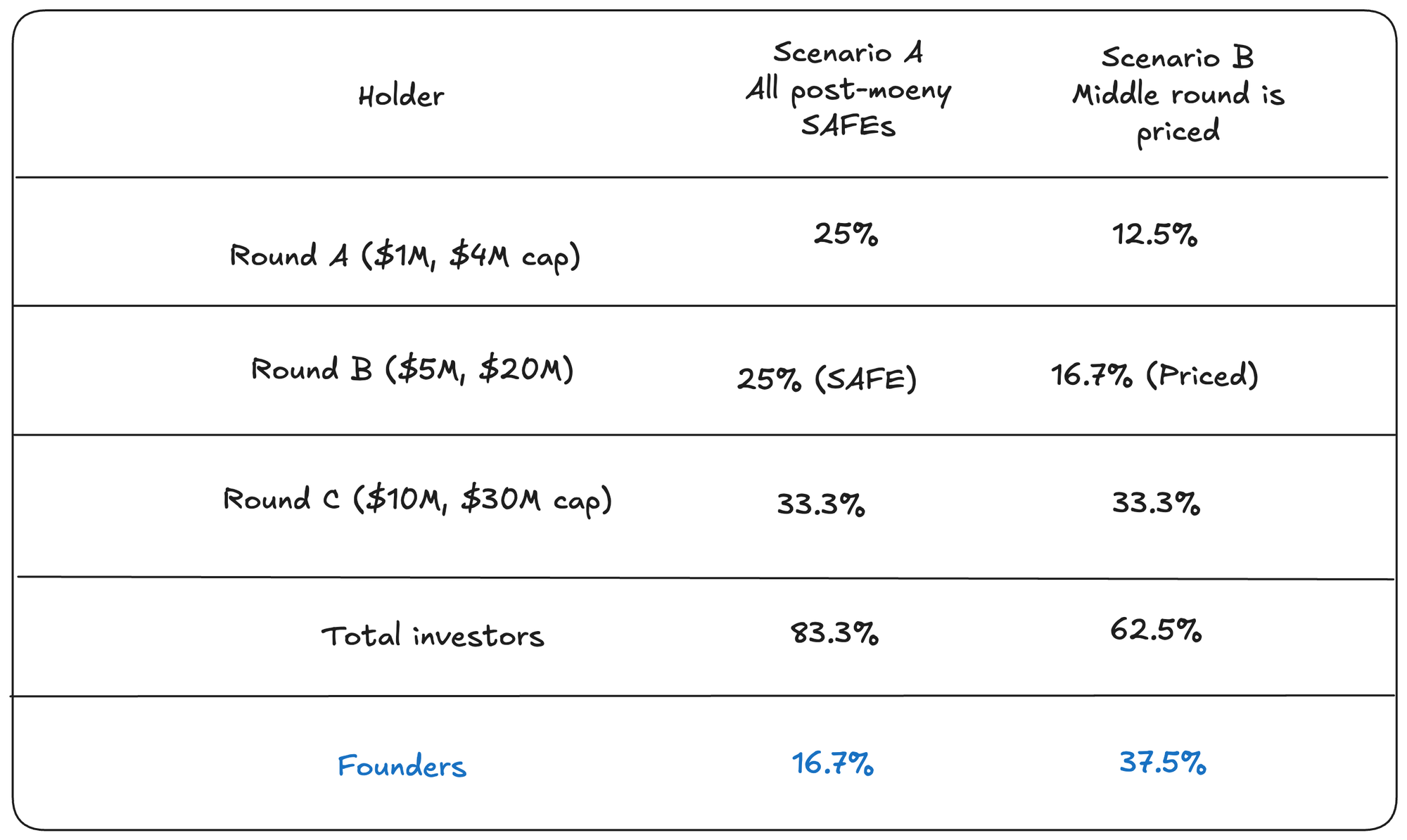
In the first scenario, the founders hold around 16.67%. In the second, they hold 37.5%.
The only difference was that in the second round, the second company used a price round.
Let’s see how it happened:
A company raises $1M at a $4M post-money, $5M at a $20m post-money, and $10M at a $30M post-money.
Scenario 1: three stacked SAFEs
In the first scenario, where the company raises three post-money SAFEs, it sells 25% in the first two rounds and 33.33% in the last SAFE. As discussed in the last post, a post-money SAFE fixes each investor’s percentage, so a later SAFE doesn’t dilute the earlier SAFE holders; all dilution falls on the existing shareholders. That’s the reason the three percentages just add up.
It means that after the three SAFEs convert, they collectively account for 83.33% of the company, leaving the founders with around 16.67%.
Scenario 2: a priced round in the middle
But if the company raises the second round through a priced round, the cap table after the third SAFE converts looks materially different. A priced round issues real shares, so everyone on the cap table dilutes together, not just the founders: the first investor dilutes to 12.5%, the priced round’s investor holds 16.67%, and the third SAFE stays with 33.33%. This brings the total to 62.5% for investors and around 37.5% for the founders.
Another point is the option pool. In SAFEs, options granted to employees or consultants when the SAFE is outstanding do not dilute the SAFE investors. But when the SAFE converts to shares, they share the dilution from future options like any other shareholder.
What this means
What we can learn from this is that when SAFEs keep being stacked, dilution can be detrimental to founders. They can ease their shareholding dilution by adding a priced round between SAFEs.
Also, pay attention to the MFN clause on your earlier SAFEs. If a later SAFE comes in at a better cap, an MFN holder can adopt that cap too, so the earliest money quietly ends up claiming more shares, and again it's the founders who absorb it.
Why Crypto Stacks SAFEs
In crypto companies, we see SAFEs stacking often. When the company focuses on the token and equity is seen as less material, investors and companies tend to put more effort into negotiating token-related terms, such as token warrants, and avoid negotiating terms for priced rounds related to the company's equity. Also, VCs want to secure their token allocation, which is largely determined by the warrant, and avoid negotiating other sections that likely won’t be relevant to the company, such as a public offering via an IPO. On top of that, VCs enjoy not being diluted when they use SAFEs. That’s why we see many companies repeatedly use SAFE + Warrant and avoid priced rounds.
Also, in priced rounds, investors are issued shares and the company's governance is put in place. In crypto companies, there is less investor appetite for board seats and veto rights. Some funds prefer to stay passive, since active participation on the board increases liability.
So we see that many investors prefer to stack SAFEs, and because no shares are issued and founders look at each SAFE on its own, the founders aren’t aware of how much dilution they are absorbing until the conversion happens, and then it might be too late. And the gap isn't small; for founders who never model the full stack, the difference between the dilution they expected and what they actually take can run into double digits.
Summary
A SAFE is a great tool for companies: it’s quick to close, the legal work is relatively inexpensive, and it lets the company raise money over time. However, using it repeatedly and avoiding priced rounds can cause significant dilution to current shareholders (founders, employees).